College Admissions and the Commodification of Experience

When ivy dies.

When ivy dies.

The academic social-media-o-sphere has been abuzz for the past couple of weeks with discussion of William Deresiewicz’s piece in the New Republic entitled “Don’t Send Your Kid to the Ivy League.”  The piece was an obvious piece of clickbait (as Salon put it in their subheading, “it’s all such excellent sport: graduating from great colleges, then creating click-bait telling other people not to”), but it raised some issues that are important in higher education circles, especially in the context of the mounting so-called “war on college” that is increasingly coming from both ends of the political spectrum.  Deresiewicz’s basic thesis is that “elite education manufactures young people who are smart and talented and driven, yes, but also anxious, timid, and lost, with little intellectual curiosity and a stunted sense of purpose: trapped in a bubble of privilege, heading meekly in the same direction, great at what they’re doing but with no idea why they’re doing it.”  In other words, the hyper-competitive world of hyper-elite American higher education is creating achievement robots rather than thoughtful people, and providing credentials rather than education.  The elite system has so thoroughly lost its way, Deresiewicz argues, that parents should, gasp, send their children to public universities. Read more


LOLmstead: 19th Century Landscape Design and Penises


Olmstead would have disapproved of the symmetry

Olmstead would have disapproved of the symmetry.

This tumblr has been making the social media rounds among my running friends, and it’s easy to see why, because it’s brilliant.  A copywriter named Claire Wycokoff has been using the run tracking feature of her Nike+ to draw (mostly crude) designs on the city maps of San Francisco and Richmond.  It’s like Etch-a-Sketch for grownups; how great is that?  And she’s hilarious.

But as a historian of 19th century landscape aesthetics, what jumped out at me immediately was how creatively Claire has used and reused the gently curving paths characteristic of post-Olmstead landscape design to, uhhh, render the male anatomy in loving detail.  Frederick Law Olmstead, the landscape architect who designed New York’s Central Park, favored the asymmetrical designs, rough edges, native plantings, and curving paths of the English pastoral style, which was itself influenced by late-18th and early-19th century discussions of “picturesque landscape” (a topic about which I have a fair amount to say).  Although neither Byrd Park nor Golden Gate Park were designed by Olmstead, they were very clearly inspired by him and squarely within the tradition of late 19th century public landscape design.

Although these parks’ curving paths were originally designed to give city dwellers the illusion of being in the countryside, it turns out they’re very useful if you’re trying to draw rounded patterns on an otherwise unforgiving city grid.  Like, say, male genitalia, instead of robots or strippers.  Claire uses these curves to draw penises in some very creative ways.  We should all be thanking Frederick Law Olmstead for making cruve-drawing in adult Etch-A-Sketch so much easier than it was in the kiddie version.

Dormer-on-a-Crane

Dormers Away!

Dormers Away!

This post is the sequel to last December’s “Columns-n-a-crate,” which are both part of the great series entitled Virginia Architectural Pastiches.  The new Campus Center is getting its dormers lowered on with a crane.  Must have been acquired at Antebellum Greek Revival Features-R-Us.

Reflections on #SHEAR14

The analog program cover.

The analog program cover.

I just returned home from my most digitally enhanced annual meeting of the Society for Historians of the Early American Republic (SHEAR) yet, so it only makes sense that I capture my reflections on that experience in digital form.

As always, I am impressed by what a generous group of scholars has been drawn to SHEAR’s flame.  With a few exceptions, the official comments and audience questions were gentle, constructive, and aimed at enhancing our understanding of the past rather than scholars’ egos.  And I think this spirit is extra impressive in a group of people who study a period in which the American ideology of competitive individualism was first finding its footing and its ideological power. Read more

Tantalizing Title of the Week

The Mind Boggles

The Mind Boggles

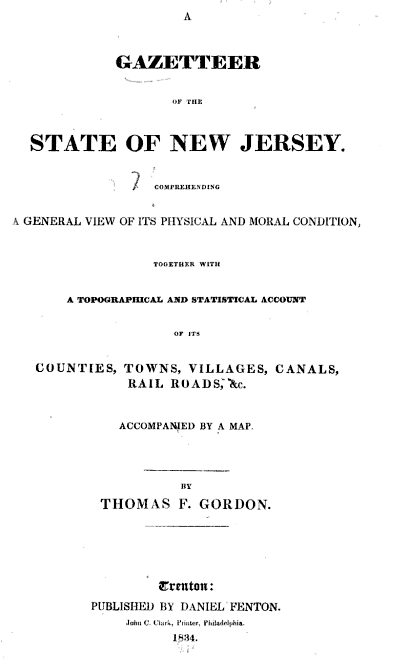
Thomas Gordon, A Gazetteer of the State of New Jersey: Comprehending a General View of Its Physical and Moral Condition, Together with a Topographical and Statistical Account of Its Counties, Towns, Villages, Canals, Rail Roads, &c., Accompanied by a Map (Trenton, 1834).  Who wants to know what the moral condition of New Jersey was in 1834?  Also, I applaud Gordon’s brevity, given the average length of nineteenth century gazetteer titles.

The Great Tim’s Mart Scavenger Hunt

Tim's Mart

Tim’s Mart

This post goes out to Fredericksburgers, history buffs, online sleuths, and students who could use a little bit of cash.  A scavenger hunt is on.  The building housing Tim’s Mart at 1010 Caroline Street in downtown Fredericksburg is for sale, and the city’s Department of Economic Development needs an old picture of the facade, dating from before 1955.  They need it so badly that they’re offering a $500 reward to anyone who can turn one up before December 31.  So it’s time to hone your digital and analog archival skills, crack open old newspapers and dusty cardboard boxes, and start looking for early twentieth century Fredericksburg streetscapes. Read more

The Politics of Trigger Warnings

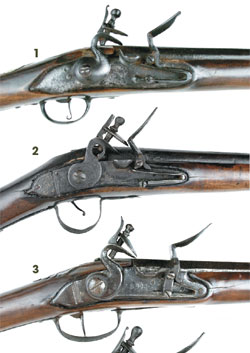
Wait, not this kind of trigger? asks the early Americanist.

Wait, not this kind of trigger? asks the early Americanist.

Up until now, I’ve avoided weighing in on the debate about “trigger warnings” that has been raging across the humanities.  The debate, as I understand it, is over whether or not professors and other pedagogues are responsible for warning students and other audience members about sensitive or controversial material that might elicit a strong emotional reaction or be traumatically “triggering.”  The paradigm here is therapeutic, and the analogy is PTSD.  The debate turns around who is silencing whom (see here for example): does traumatic material silence the traumatized?  Or do trigger warnings silence those who would explore difficult material?  I have stayed out of the debate so far because I’m divided on the issue myself.  I’m skeptical about catering too much to students’ emotional needs, because isn’t the point of education to be challenged? But at the same time, my training as a historian has taught me the fundamental limitations of my own ability to understand others’ experiences, so who am I to say what might be “triggering” or not?  But the whole discussion has sat uncomfortably with me over the past months.  Finally, at long last, Jack Halberstam has laid out a set of objections to trigger warnings that capture my inarticulate sense of discomfort better than I have been able to do myself. Read more

Welcoming Us Home

We did this, literally, in 2010.

We did this, literally, in 2010.

It’s been two weeks since Brian and I got married, and a little over a week and a half since we returned to Virginia from where we got married in New York. We went back north to get married because we’re both from New York, much of our family is still there, and because, well, it’s legal in New York, and not in Virginia. Our return to Fredericksburg was the subject of some comment around the time of the wedding. A heckler during the toasts made a joke about the discrimination we would face upon returning home, and I also made a comment on Facebook about becoming legally unmarried when crossing the Potomac. Read more

A Very Special Virginia Anti-Marriage Equality Argument

This shining example of traditional marriage is why the the gays can't have any.

This shining example of traditional marriage is why the the gays can’t have any.

David Cohen in Slate has brought word of what he calls “The Worst Argument Ever Made Against Gay Marriage,” made last week before the Fourth Circuit in Richmond.  The occasion was the state’s appeal of the Eastern District of Virginia’s decision in Bostic v. Schaefer that the Commonwealth’s constitutional ban on gay marriage is unconstitutional.  The attorney defending the ban, David Oakley, made a brave foray into Virginia history in order to show Virginia’s “traditional” support for opposite-gender marriages.  That’s right, the gays can’t get married in Virginia because of Pocahontas. Read more

Silicon Valley: World Headquarters of Doublespeak

Range Rover or no, this isn't a sign of economic health.

Range Rover or no, this isn’t a sign of economic health.

Although Orwell never used the term “doublespeak” (he preferred the more insidious “doublethink”), the term has become indelibly associated in the modern day with the dystopian totalitarian future of his classic novel 1984.  In its common usage, “doublespeak” refers to any language that exploits linguistic ambiguity in order to describe a negative reality in positive terms.  For most Orwellian-inspired users of the term, it generally has a political connotation. It refers to political speech that tries to mislead citizens and subjects, towards the end, as Orwell put it, of “the defence of the indefensible.”  But I think the most skillful current users of doublespeak are the corporate promotors and wild-eyed futurists of Silicon Valley, along with their natural allies, the armies of TED talk speakers that have infested our public discourse.  The evangelists of the new digital age have perfect the art of packaging proletarianization as progress, and making us thank them for it. Read more

css.php