Obama Agrees With Me

Pretty much.

Pretty much.

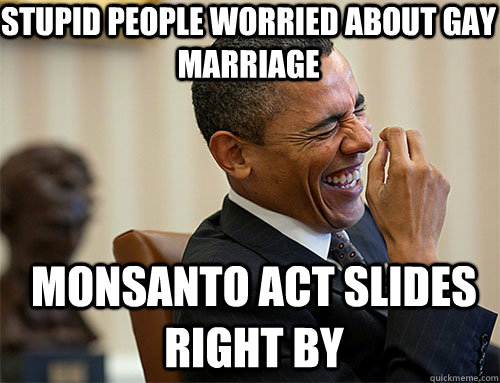
Back in October, during the catharsis after Virginia gay marriage legalization, I argued that “the political momentum for gay marriage has built so quickly because it has become a treacly feel-good issue for liberal politicians who want to deliver a win to their social-liberal base without actually challenging the mechanisms of power in this country … everybody outside of the religious right has come to support gay marriage, because it feels liberal, progressive, warm, comfortable, human, and uplifting, but it doesn’t cost money to anyone who has real political power.”  I framed the argument in material (and probably also cynical) terms: gay marriage is part of a larger strategy to force the broader American public into a kind of D.I.Y. social welfare, in which the government ducks its social responsibilities in the name of “family.”  Well, it turns out Barak Obama agrees with me, sort of.
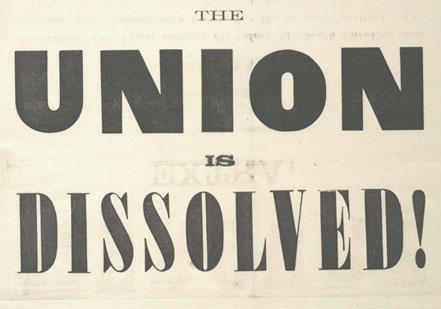
Read more

Exploring Modern Popular Meanings of Capitalism

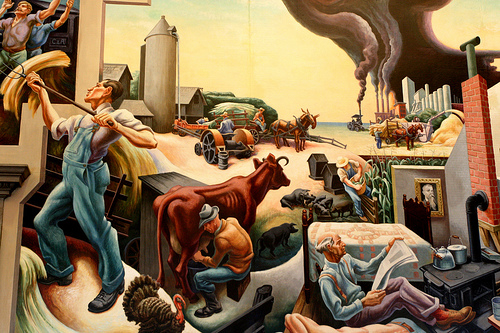
Thomas Hart Benton's A Social History of the State of Missouri, 1936

Thomas Hart Benton’s A Social History of the State of Missouri, 1936

This semester I am teaching a new course that I’m very excited about, which I’ve titled Cultural History of Capitalism, which will mostly focus on the United States.  It’s a senior-level undergraduate seminar, in which we will study some economic history in order to understand the origins, evolution, and importance of capitalism as an economic system, but in which we will mostly read scholarship from the recent historiography on the cultural history of capitalism. As the class dives into this new scholarship, I plan to explore the moments of contingency where capitalism was implemented, the lived experiences of capitalism, and the specific social and cultural processes by which capitalism came to be seen as the natural and proper economic system for the United States and humanity as a whole. I hope that the course will ultimately work to understand and displace modern narratives of capitalism’s inevitability by showing how it was constructed and legitimated in history. Read more

Independent Upstate Has a Name

Or not.

Or not.

Secession movements have a rich history in New York State.  Alexander Hamilton, a politician who made no small plans, began by threatening to push for New York City’s secession from the broader state during the New York’s ratifying convention in 1787-1788, a means to undermine the power of anti-Federalist governor George Clinton.  Since then, figures ranging from Fernando Wood, colorful Confederate-sympathizing mayor during the Civil War, to Norman Mailer during an idealistic counterculture-fueled bid for the mayoralty in 1969, have pushed to pull New York City out of New York State.  More recently, pushes for secession have come from the upstate side.  In the 1990s, a state senator from western New York named Randy Kuhl began to push for upstate secession, and the cause has been taken up in the early twenty-first century by tea party and libertarian types who frame it as an appropriate response to the perceived political and economic domination of the New York metro area. Read more

I Couldn’t Have Said It Any Better Myself

The look like they need a tax break, don't they?

The look like they need a tax break, don’t they?

With the latest news out of the Sixth Circuit in Cincinnati, the march towards a national resolution of the gay marriage question has hit a roadblock.  By a 2-1 majority, a 3-judge panel of the 6th circuit upheld gay marriage bans in Kentucky, Michigan, Ohio, and Tennessee.  In doing so, they have bucked the recent national trend in which all circuit court-level decisions have found in favor of gay marriage.  I have mixed feelings about this development.  On the one hand, it creates a split between the circuits, which makes it much more likely that the Supreme Court will take up the issue and settle it once and for all.  On the other hand, I don’t like anything that messes with the the sense of inevitability that the recent string of decisions has created, because despite the marriage triumphalism of my recent post, I don’t trust the Supreme Court to get this issue right.  In fact, I don’t trust this Supreme Court to get anything right, after the past few years of largely disastrous rulings. Read more

A Special Halloween Post

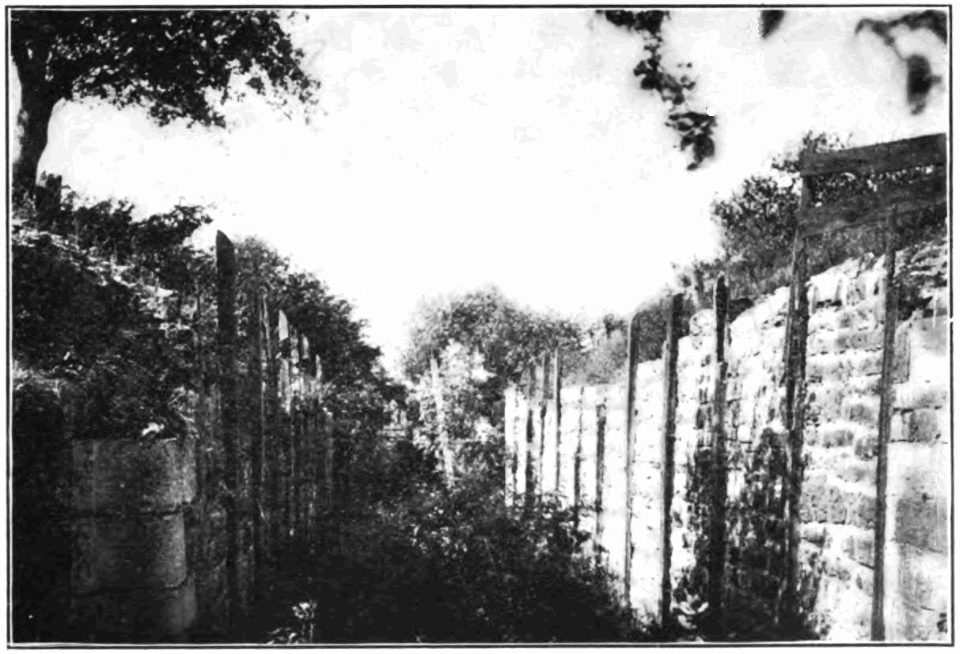
Abandoned Oneida Lake Canal, from "Abandoned Canals of the State of New York," Popular Science Monthly 75 (September 1909)

From “Abandoned Canals of the State of New York,” Popular Science Monthly 75 (September 1909)

It’s that time of year again: Halloween, and map quizzes in my US History survey.  These two events converge in the single most common undergraduate typo: the labeling of the “Eerie Canal” through upstate New York.  Reliably, every year a solid quarter of the class makes this spelling error.  (I blame their being educated largely in Virginia, which means that didn’t get a solid year of Erie Canal propaganda in 4th grade.)  This excellent typo raises a whole range of questions about what the “Eerie Canal” could possibly refer to.  But I demure.  Instead, I’ll take the occasion to quote a great paragraph from Nathaniel Hawthorne’s scathing description of traveling the Erie Canal, which he published in 1835 in the New-England Magazine.   Read more

Gay Marriage Was The Easy Fight

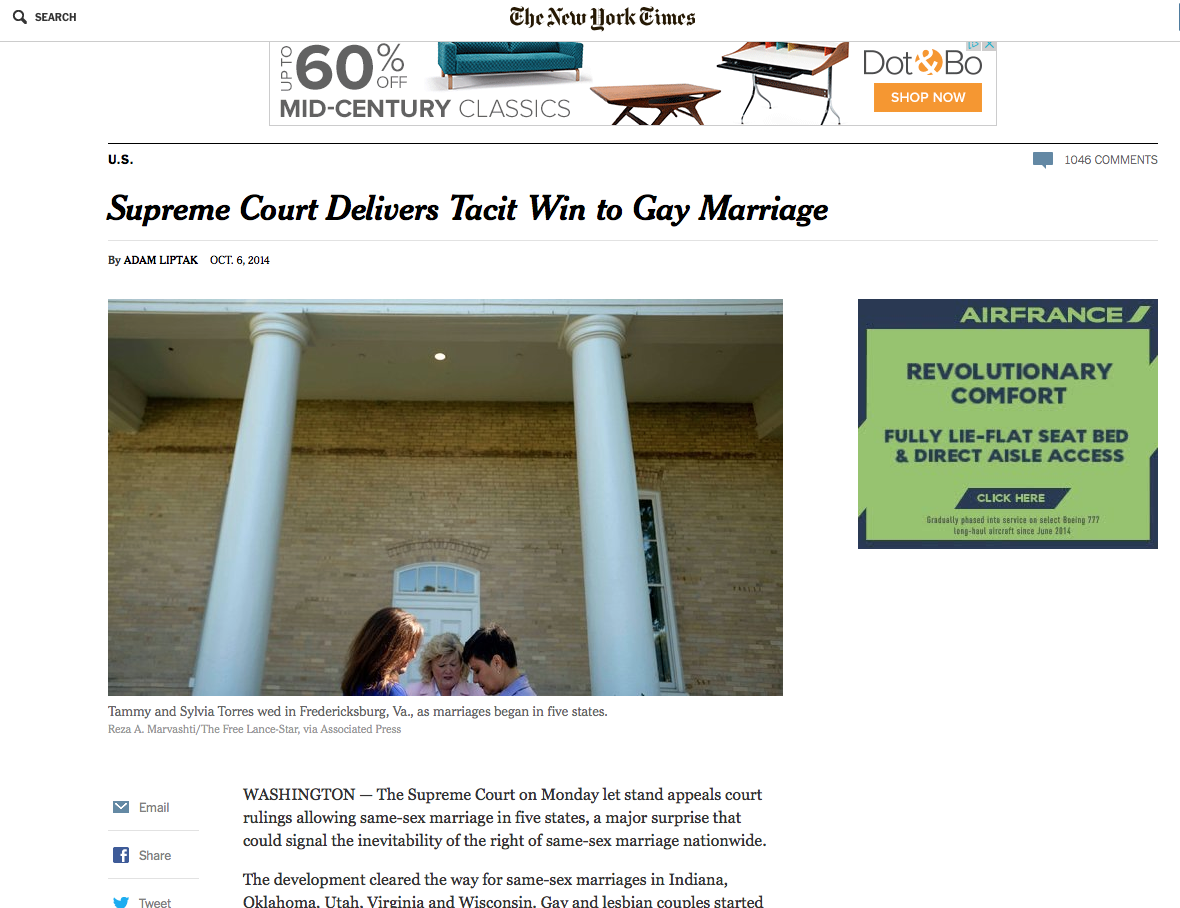
Fredericksburg's Big Day! A local wedding made the NY Times.

Fredericksburg’s Big Day! A local wedding made the NY Times.

Undoubtedly, the last few days has been an emotional roller coaster of excitement and triumph, from the Supreme Court’s unexpected and exciting denial of cert, to the almost immediate changes that began to appear on the landscape here in Virginia.  These changes have been undeniably meaningful and beneficial for my family, my town, the state, and the nation.  And with the more recent news coming out of the Ninth Circuit, it looks like the party is about to get bigger.  But now that we’ve had a chance for our modest, middle-of-the-semester-and-approaching-middle-age celebrations, it’s time to remember that there’s much more work to be done, work that’s both arguably more important and much harder.  Gay marriage is a good start, but it doesn’t actually truly address the structures of wealth and power in this country. Read more

I Guess It’s Over (For Us)

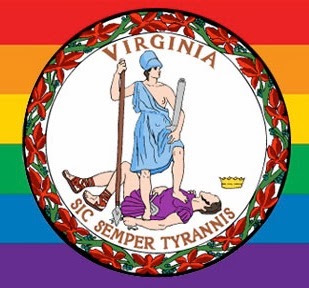
GayVirginia

Nice draping, there, Virtus.

For those of you who haven’t been glued to your computer all day, today the Supreme Court denied cert on gay marriage appeals cases from the Fourth, Seventh, and Tenth Circuits. In each of those cases, the circuit court had overturned gay marriage bans, and marriage opponents had appealed the decision to the Supreme Court.  Also in each of those cases, the decision had been stayed pending the court’s ruling.  By denying cert, the Supreme Court declined to hear the cases, meaning that the circuit courts’ pro-gay marriage rulings stand, and also that the stays are lifted immediately.  The fives states whose bans were the subjects of these cases (Virginia, Oklahoma, Utah, Indiana, and Wisconsin) will begin gay marriages more or less immediately.  The other states covered by those three circuits, but where gay marriage isn’t already legal (Wyoming, Colorado, Kansas, West Virginia, North Carolina, and South Carolina), will have their bans overturned as soon as the circuit courts can make those specific rulings.  Virginia Attorney General Mark Herring announced this morning that as of 1:00 PM today, Virginia would begin issuing marriage licenses to same-sex couples, and the state would begin recognizing out-of-state marriages. Read more

The Moral Entanglements of Defending Capitalism

Looks like capitalism to me.

Looks like capitalism to me.

The early Americanist internet exploded last night with the news that The Economist had given a negative review to Ed Baptist’s magisterial new book, The Half Has Never Been Told: Slavery and the Making of American Capitalism.  The shocking part is that the main criticism of the book is that “Mr Baptist has not written an objective history of slavery. Almost all the blacks in his book are victims, almost all the whites villains. This is not history; it is advocacy.”  Although this is the most damning quote, the whole review is pretty breathtaking; the anonymous reviewer’s main complaint seems to be that Baptist failed to consider the possibility that maybe slaves were treated well because “Slave owners surely had a vested interest in keeping their ‘hands’ ever fitter and stronger to pick more cotton. Some of the rise in productivity could have come from better treatment.”  Despite the fact that all existing evidence argues against this hypothesis, the reviewer seems to think that there might be some magical never-before-seen document that Baptist could have consulted to somehow show that this was the case.  The review was withdrawn today, thankfully, amid much speculation about what could have caused The Economist to publish it in the first place. Read more

The “Coarsening of Culture” in Historical Context

Yup, culture definitely wasn't coarse in 1831.

Yup, culture definitely wasn’t coarse in 1831.

The twin horrors of Ferguson and James Foley have been bombarding me this week, and each has offered plenty of opportunities for observers to complain about the “coarsening of culture.”  Predictably enough, right-wing commentators have attributed both Michael Brown’s death and the resulting unrest in Ferguson to a “coarsening of the culture,” an absurd attempt to blame the victim akin to blaming school shootings on video games.  Less predictably, I caught Bobby Ghosh (who I think is great otherwise) attributing the wide circulation of the James Foley beheading video to “a coarsening of culture” on WHYY’s Radio Times.  Getting it from all sides like this makes me want to weigh in, because the “coarsening of culture” narrative is a particular pet peeve of mine. Read more

Sowing Chaos in Virginia

From An Authentic and impartial narrative of the tragical scene which was witnessed in Southampton County (Virginia) on Monday the 22d of August last...

From An Authentic and impartial narrative of the tragical scene which was witnessed in Southampton County (Virginia) …

Today the Fourth Circuit in Richmond denied the Prince William County Clerk Michele McQuigg’s request that they stay their decision finding Virginia’s gay marriage ban unconstitutional.  This is obviously great and welcome news, not least because the Family Foundation of Virginia thinks it will be a disaster.  (Pretty much anything they think will be a disaster is by definition a good thing.)  Their president, Victoria Cobb, said of the decision, “It’s shocking that the 4th Circuit has introduced chaos to Virginia.”  So gay marriage advocates are the ones introducing historic chaos to Virginia?  My dear Ms. Cobb, Nat Turner would like to have a word with you.  That is all I have to say about Victoria Cobb and the Family Foundation of Virginia.

css.php