
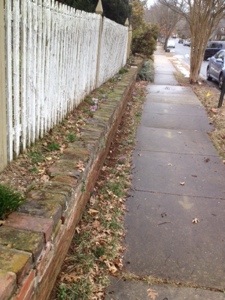
 After the craziness of the recent weeks of blizzards and snow days, it’s 70 in Fredericksburg, with a tornado warning (!!!!!!!) and a solid thunderstorm almost worthy of July. Although it’s supposed to get cold again next week, no one told these poor crocuses. This is why I love the term “global weirding” so much.
What Polar Vortex?
Category: Squirrels that Caught My Attention /
Books Reunited
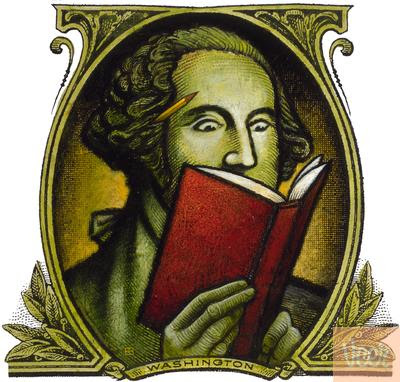
That pencil probably didn’t get much use.
Back in January, I had the opportunity to tour the gorgeous new Fred W. Smith National Library at Mt. Vernon, as part of a reception that they hosted for SHEAR. It’s truly a gorgeous facility, with lots of resources to support scholars interested in studying “George Washington, Colonial America, and the Revolutionary Era.” One of their initiatives is the laborious (and mind-numbingly expensive) reconstruction of Washington’s personal library. Where possible, they are trying to get the actual books owned by Washington; where that is impossible, they are attempting to acquire another copy of the same edition of the same work. When they’re done, visitors will be able to sit in a (heavily surveilled) room surrounded by the same books that surrounded Washington when he was at home.
Category: Historian in the World /
Crowdsoucing Project: Bad Historical Websites

What a terrible website! (Just kidding. Thanks, Geocities-izer!)
On Wednesday, I will be leading a discussion in my undergraduate History Practicum seminar about learning to distinguish between reliable and unreliable sources on the wide-open Internet. The students have been assigned to bring in an example of a good and a bad historical website on their topic, but I would like to have my own examples of some spectacularly bad history websites to pick apart in class. I want websites that are factually wrong, absurdly presentist, politically problematic, and straight-up plagiarized. So what’s your favorite example of bad historical website? Email it to me or post it in the comments below.
Oh, and I guess I’m also interested in your favorite example of good history websites, too. Thanks, collective cloud-brain!
Analog Day, Digital Day
Virginia Snowpocalypse 2014: digital humanities or analog humanities?
This week’s assignment to explore “personal learning networks” through social media came at an auspicious time. Unlike Jason and Dave, last week’s snow days freed up some time for me, because of the particular moment I was in for each of my courses. (I’m screwed this week, but that’s another story.) That meant I had a fair amount of time on Thursday and Friday to play with Twitter and RSS. Read more
Category: Digital Life, The Aspiring Handyman / Tags: Analog Humanities, architecture, Brian, Digital Humanities, fi, Fredericksburg, historic district, PLN, TTRSS, twitter
Wait It Out
 Back in 2010, when Brian and I moved Virginia, one of my biggest reservations was moving from New York, a state with relatively good legal protections for our relationship, to Virginia, which not only had a spectacularly vindictive anti-gay constitutional amendment, but also had a spectacularly colorful history of being on the wrong side of diversity and family issues. I was excited for the new chapter in my life, excited for the job at UMW, and excited to try living in the quaint little town of Fredericksburg. But Virginia … oh, Virginia … so beautiful, and so backwards.
Category: Squirrels that Caught My Attention /
Snow Day
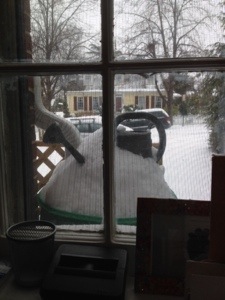 Disappointing those who expected to be disappointed, last night’s snowstorm delivered on its promise of real, if icy, accumulation. (Myself, I was expecting real snow, mostly because I was taking the word of Chris White, fredericksburg.com’s weather blogger, who I am increasingly becoming a fan of for his thoughtful and articulate posts about local meteorology.) Read more
Back off, Fredericksburg
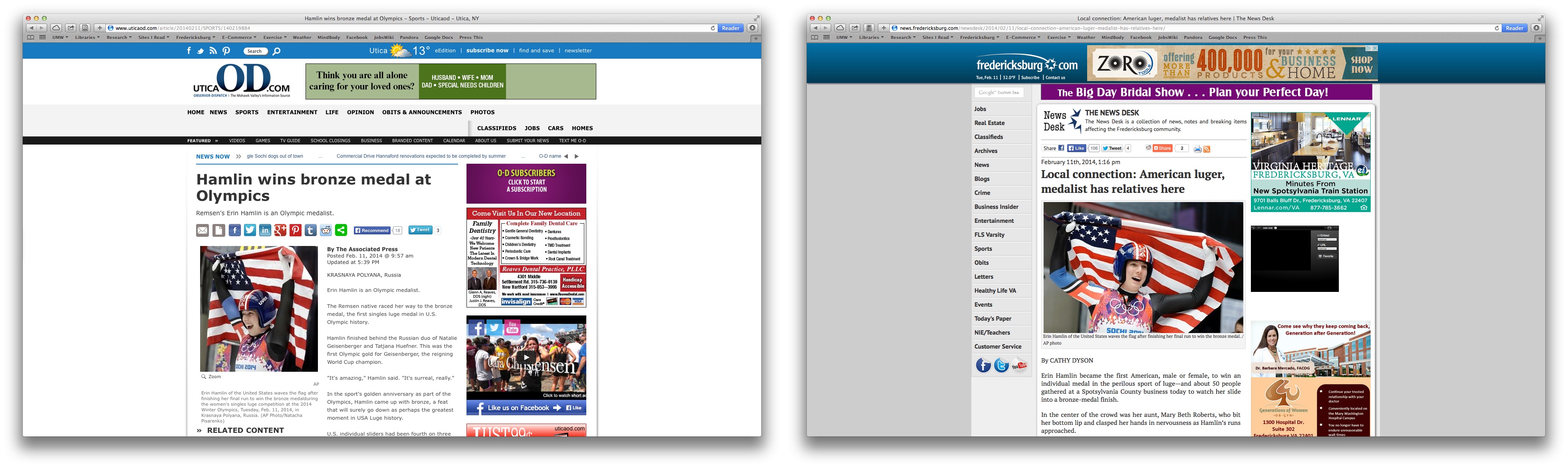
Whose claim is more legitimate?
I clicked on this Free Lance-Star article about Erin Hamlin, the American who just won the bronze in luge in Sochi, expecting to find a feel-good human-interest story about a local athlete made good. Which is exactly what I found. Except that Hamlin isn’t from Fredericksburg (her aunt lives here), she’s from Remsen, New York, just outside of Utica. And now I’m mad because Fredericksburg is squatting on the local-girl-made-good human-interest story that rightfully belongs to my people. Lay off Oneida County, will ya? They’re in a 50-year drought of feel-good human-interest stories up there.
In Which I Enjoyed City Bureaucracy
 This evening Brian and I attended the monthly meeting of the City if Fredericksburg’s Architectural Review Board. We had a proposal before the board, seeking their approval to replace the entry door and add some signage to Skin+Touch Therapy‘s new location on Caroline Street. Since the building dates to 1839 (although the ARB claimed 1820!) and it sits in the middle of the he historic district, we have had to go through endless layers of both structural and aesthetic approvals for all the renovations we have needed to make. I have to say I was a bit nervous about appearing before there ARB, because after all, aesthetics doesn’t seem like a comfortable area of expertise for a city bureaucracy. But I was really impressed with the meeting. The members of the board all seemed to have a clear architectural vision, and it wasn’t one that was hidebound or historico-pedantic. They quickly approved the proposals that were easy no-brainers, and asked thoughtful questions about the tougher calls. All in all, it made me very glad to be locating in the historic district, despite the extra bureaucracy.
Category: Squirrels that Caught My Attention, The Aspiring Handyman / Tags: architecture, Brian, Fredericksburg, historic district
Making a Collaborative Reading Notes Wiki
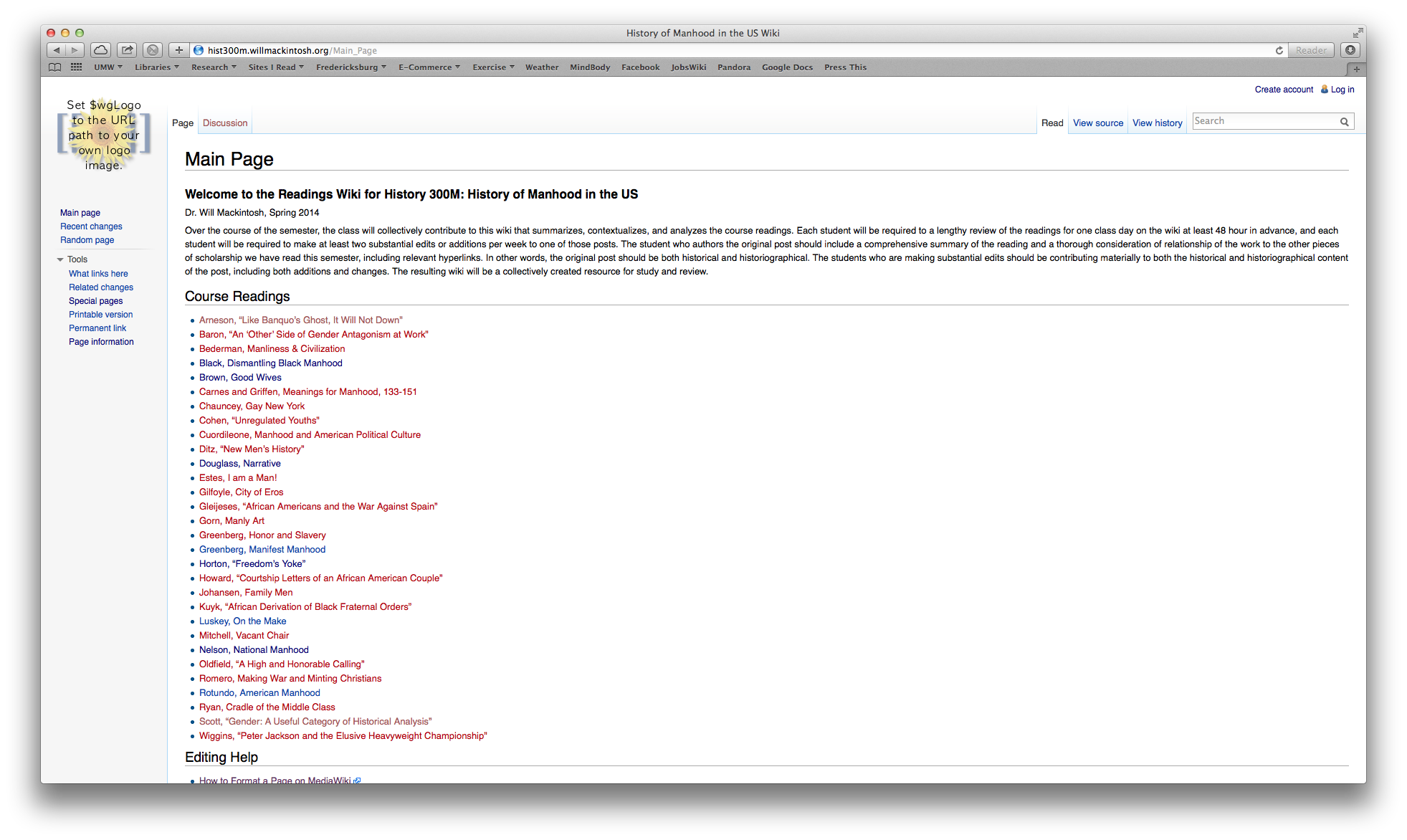
Screen shot of the wiki in progress; click to enlarge.
This semester I am experimenting with using MediaWiki as a platform for the students in my History of Manhood in the US course to build a collaborative set of reading notes. After being less than completely satisfied with my Twitter experiment last semester, I was looking for a new way to integrate an online component into my courses. One of the problems I had with student tweeting is that it generated a lot of noise; there was a lot of talking and very little listening. I had a hard time keeping up with all the tweets, and it seemed unreasonable (as well as unproductive) to expect the students to do so. In previous years, I had found that response-blogging suffered from a similar problem; there was an awful lot of expression and not a lot of contemplation. So I found myself searching for a different kind of online community, one in which the students wrote less but more thoughtfully, and actively engaged with what the others were contributing. Read more
Twitter as an Academic Tool

Is it a siren song that I sing?
This week’s assignment for the Domain of One’s Own Faculty Initiative is to explore online scholarly communities. I spent some time racking my brain trying to think up Early Americanist communities online, until I realized that I have been an active user of just such a community for years, H-Net. I belong to several of their groups, and I get much of my information about fellowships, conferences, and new work from interacting with their email listservs and their newly renovated web portal. The size and breadth of its user community makes it an invaluable resource for me. Read more
