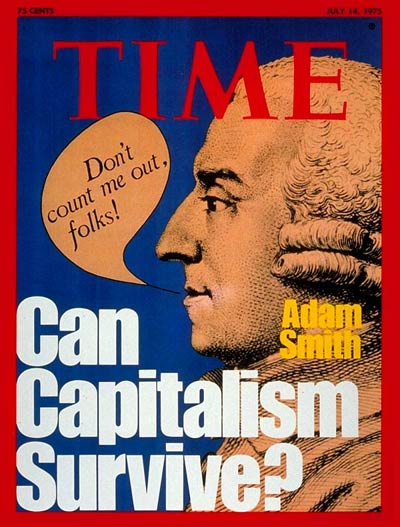
Back in January, I posted about a project that my Cultural History of Capitalism seminar was undertaking this semester. Students in the class had to go out and interview three people about how they understood both the meaning of capitalism as well the history of capitalism, and then they had to write a reflection post on their conclusions about popular meanings and histories of capitalism, and how those popular understandings match up with the scholarly literature on the subject. The project is done, and it has turned out to be an interesting and revealing, if not particularly surprising, exercise in muddiness. The class’s interviewees often had strong feelings about capitalism, which showed a good deal of variation from strongly positive to strongly negative to deeply ambivalent. But when we pushed harder, the interviewees generally had a difficult time saying exactly what capitalism was, and an even harder time tracing its history. People knew it had something to do with “markets,” and often “freedom,” and that it came from England, and that Adam Smith was an important guy. Beyond that, most of the interviewees demurred.
Tag Archive for pedagogy
Exploring Modern Popular Meanings of Capitalism
This semester I am teaching a new course that I’m very excited about, which I’ve titled Cultural History of Capitalism, which will mostly focus on the United States. It’s a senior-level undergraduate seminar, in which we will study some economic history in order to understand the origins, evolution, and importance of capitalism as an economic system, but in which we will mostly read scholarship from the recent historiography on the cultural history of capitalism. As the class dives into this new scholarship, I plan to explore the moments of contingency where capitalism was implemented, the lived experiences of capitalism, and the specific social and cultural processes by which capitalism came to be seen as the natural and proper economic system for the United States and humanity as a whole. I hope that the course will ultimately work to understand and displace modern narratives of capitalism’s inevitability by showing how it was constructed and legitimated in history. Read more
The Politics of Trigger Warnings
Up until now, I’ve avoided weighing in on the debate about “trigger warnings” that has been raging across the humanities. The debate, as I understand it, is over whether or not professors and other pedagogues are responsible for warning students and other audience members about sensitive or controversial material that might elicit a strong emotional reaction or be traumatically “triggering.” The paradigm here is therapeutic, and the analogy is PTSD. The debate turns around who is silencing whom (see here for example): does traumatic material silence the traumatized? Or do trigger warnings silence those who would explore difficult material? I have stayed out of the debate so far because I’m divided on the issue myself. I’m skeptical about catering too much to students’ emotional needs, because isn’t the point of education to be challenged? But at the same time, my training as a historian has taught me the fundamental limitations of my own ability to understand others’ experiences, so who am I to say what might be “triggering” or not? But the whole discussion has sat uncomfortably with me over the past months. Finally, at long last, Jack Halberstam has laid out a set of objections to trigger warnings that capture my inarticulate sense of discomfort better than I have been able to do myself. Read more