Tag Archive for Capitalism

Capitalism is an Empty Signifier

Yes, definitely, assuming anyone can tell you what capitalism actually is.

Yes, definitely, assuming anyone can tell you what capitalism actually is.

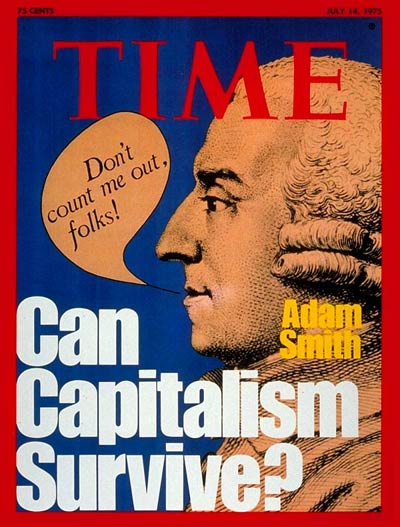
Back in January, I posted about a project that my Cultural History of Capitalism seminar was undertaking this semester.  Students in the class had to go out and interview three people about how they understood both the meaning of capitalism as well the history of capitalism, and then they had to write a reflection post on their conclusions about popular meanings and histories of capitalism, and how those popular understandings match up with the scholarly literature on the subject.  The project is done, and it has turned out to be an interesting and revealing, if not particularly surprising, exercise in muddiness.  The class’s interviewees often had strong feelings about capitalism, which showed a good deal of variation from strongly positive to strongly negative to deeply ambivalent.  But when we pushed harder, the interviewees generally had a difficult time saying exactly what capitalism was, and an even harder time tracing its history.  People knew it had something to do with “markets,” and often “freedom,” and that it came from England, and that Adam Smith was an important guy.  Beyond that, most of the interviewees demurred.
Read more

Exploring Modern Popular Meanings of Capitalism

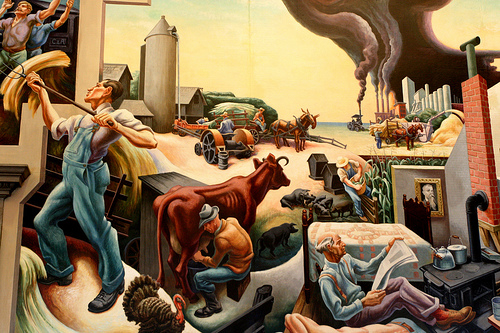
Thomas Hart Benton's A Social History of the State of Missouri, 1936

Thomas Hart Benton’s A Social History of the State of Missouri, 1936

This semester I am teaching a new course that I’m very excited about, which I’ve titled Cultural History of Capitalism, which will mostly focus on the United States.  It’s a senior-level undergraduate seminar, in which we will study some economic history in order to understand the origins, evolution, and importance of capitalism as an economic system, but in which we will mostly read scholarship from the recent historiography on the cultural history of capitalism. As the class dives into this new scholarship, I plan to explore the moments of contingency where capitalism was implemented, the lived experiences of capitalism, and the specific social and cultural processes by which capitalism came to be seen as the natural and proper economic system for the United States and humanity as a whole. I hope that the course will ultimately work to understand and displace modern narratives of capitalism’s inevitability by showing how it was constructed and legitimated in history. Read more

The Moral Entanglements of Defending Capitalism

Looks like capitalism to me.

Looks like capitalism to me.

The early Americanist internet exploded last night with the news that The Economist had given a negative review to Ed Baptist’s magisterial new book, The Half Has Never Been Told: Slavery and the Making of American Capitalism.  The shocking part is that the main criticism of the book is that “Mr Baptist has not written an objective history of slavery. Almost all the blacks in his book are victims, almost all the whites villains. This is not history; it is advocacy.”  Although this is the most damning quote, the whole review is pretty breathtaking; the anonymous reviewer’s main complaint seems to be that Baptist failed to consider the possibility that maybe slaves were treated well because “Slave owners surely had a vested interest in keeping their ‘hands’ ever fitter and stronger to pick more cotton. Some of the rise in productivity could have come from better treatment.”  Despite the fact that all existing evidence argues against this hypothesis, the reviewer seems to think that there might be some magical never-before-seen document that Baptist could have consulted to somehow show that this was the case.  The review was withdrawn today, thankfully, amid much speculation about what could have caused The Economist to publish it in the first place. Read more

css.php